
Heart catheterisation: procedure and significance in modern cardiology

A cardiac catheterisation allows for an accurate assessment of the coronary arteries and heart function. Using a thin catheter, which is advanced to the heart via a blood vessel, measurements can be taken and the vessels visualised with the aid of contrast medium. Cardiac catheterisation in Munich represents a central element for the Cardiological diagnostics Dear.

Depending on the medical question, a distinction is made between right heart catheterisation and left heart catheterisation. The following explains how such an examination proceeds, how long it takes, and what diagnostic information it provides.
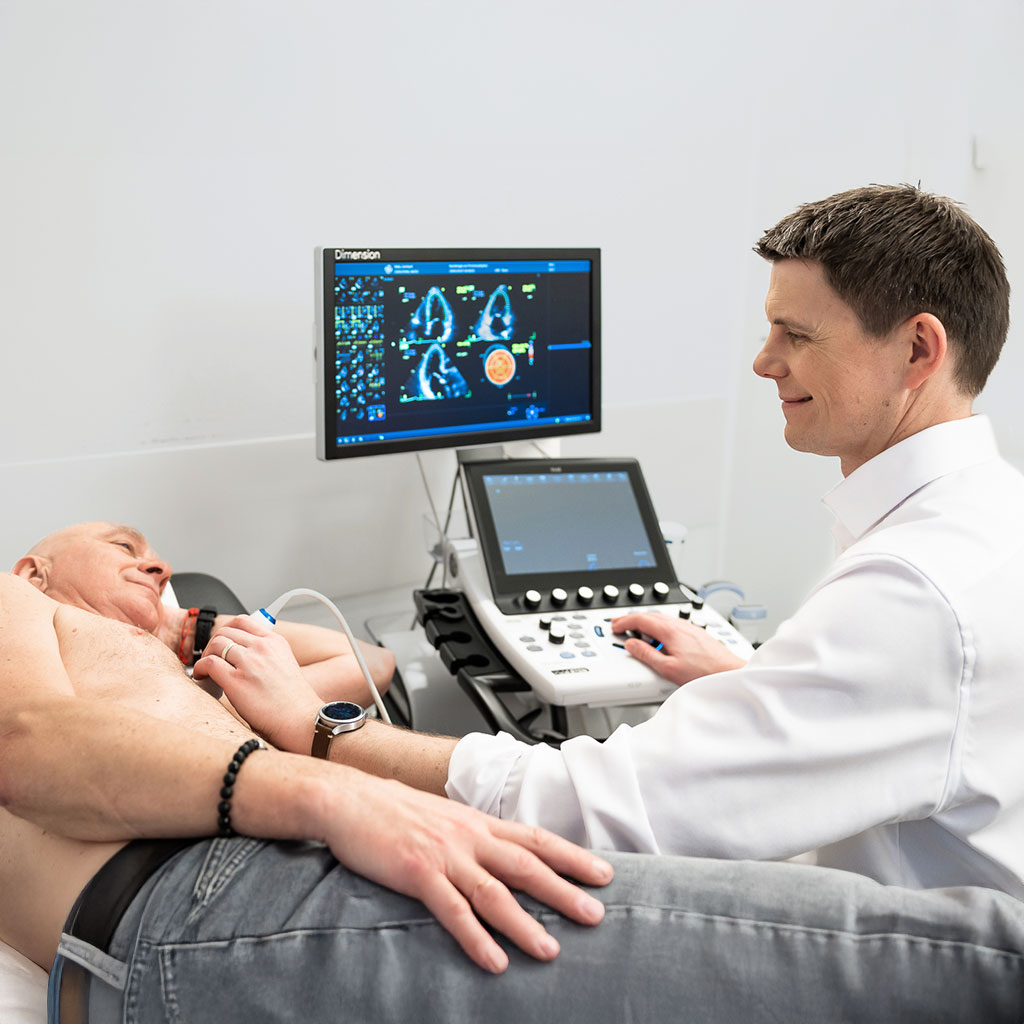
Dr Bernhard Nagel examines a patient using ultrasound.

Cardiac catheterisation overview

A cardiac catheterisation is an established invasive procedure for assessing the coronary arteries, heart chambers and heart function. It not only enables accurate diagnosis but also direct therapy, for example, for narrowed coronary arteries.

During a cardiac catheterisation, a catheter is advanced to the heart through a blood vessel. Access is usually gained via an artery in the wrist or the femoral artery. Using X-ray contrast medium, the coronary arteries and heart chambers can be visualised on a monitor. Patients remain awake and can communicate during the procedure.

A heart catheterisation typically lasts 30 to 60 minutes, though more complex procedures or additional therapeutic measures may take longer.

Indications for cardiac catheterisation

A heart catheterisation is advisable when an accurate assessment of the coronary arteries, heart chambers, or heart valves is required.

Typical indications are:

  • Suspicion of relevant coronary heart disease
  • unstable angina pectoris or acute myocardial infarction
  • coronary heart disease (CHD)
  • Myocarditis (inflammation of the heart muscle)
  • Heart valve malfunction
  • Pulmonary hypertension

Furthermore, cardiac catheterisation can be used before planned heart procedures, such as valve or bypass surgery, and as a therapeutic procedure for coronary heart disease. As Cardiology am Promenadeplatz, we are your ideal medical point of contact for cardiac catheterisation in Munich.

Risk groups and contraindications for cardiac catheterisation

A cardiac catheterisation examination is usually also possible in older patients, provided their general health permits. Cardiac catheterisation should not be performed in the following (relative) contraindications:

  • Contrast medium allergy
  • Severe renal insufficiency
  • coronary heart disease (CHD)
  • Hyperthyroidism

Furthermore, cardiac catheterisation can be used before planned heart procedures, such as valve or bypass surgery, and as a therapeutic procedure for coronary heart disease. As Cardiology am Promenadeplatz, we are your ideal medical point of contact for cardiac catheterisation in Munich.

Patient preparation for cardiac catheterisation

Thorough preparation is important before a cardiac catheterisation. This includes a detailed information and consent discussion, an ECG check, and blood tests to evaluate blood coagulation, kidney, and thyroid values. All preliminary examinations take place here in our cardiology department at Promenadeplatz. The cardiac catheterisation itself will be performed in one of our partner clinics. We will arrange the appointment in advance.

On the day of the examination, patients should be fasting. Water can be drunk in small quantities up to two hours before the procedure. Medication should be taken as directed by your doctor.

  • Immunosuppressants: take as usual
  • Metformin: stop two days beforehand, in consultation with your doctor
  • Anticoagulants such as Eliquis, Rivaroxaban, Pradaxa or Lixiana: pause
  • Marcumar: INR on the day of the examination around 2.0–2.4

The procedure for a heart catheterisation

The cardiac catheterisation procedure is performed via an arterial access point in the wrist or groin (radial or femoral artery). After disinfection and local anaesthesia, a sheath is inserted, through which the catheter is advanced to the heart under X-ray guidance.

Contrast medium is injected in minimal doses to make the coronary arteries, heart ventricles, and pulmonary arteries visible. A temporary feeling of warmth due to the contrast medium is normal.


The duration of a cardiac catheterisation procedure is usually between 20 and 60 minutes, depending on the scope of the examination or additional therapeutic measures. Sedation or painkillers can be used if necessary, as pain and pressure sensations vary individually.

Risks and potential complications of cardiac catheterisation

The cardiac catheterisation is an established routine procedure, yet as with any invasive intervention, risks and complications can occur.

Possible complications include:

  • Allergic reaction to contrast agent
  • Vascular injuries to arteries or veins
  • Bruising at the injection site
  • Unstable circulatory situation during the examination
  • Emergency bypass surgery
  • Rare: Stroke
  • Very rare: heart or lung injuries, e.g.: lung haemorrhage

Potential risks are discussed in detail in advance during the consultation in our cardiology practice with patients.

Aftercare of a cardiac catheterisation

Following the completion of the examination, the cardiac catheter in Munich will be removed and the access site closed. Finally, the puncture site will be treated with a pressure bandage or compression system to prevent bleeding. The bandage should remain in place for several hours while patients rest. Depending on their condition, patients will remain under observation on the ward for some time.

Due to taking medication for the examination, driving a vehicle immediately after the procedure is not permitted. A safe journey home should therefore be organised in advance.

Post-heart catheter

In the first few days after the examination, the puncture site should be rested to ensure optimal healing. This includes:

  • Avoid heavy lifting and carrying
  • Resume sporting activities or cycling only after consultation.
  • Avoid movements that strain the arm or groin area.
  • Avoid hot baths or swimming

This helps to prevent bleeding or post-operative bleeding and supports the healing process.

Possible after-effects

Occasionally, a small bruise might form at the injection site. This is usually not a problem as long as the bruise is soft and doesn't grow significantly. Other possible

Side effects are:

  • Drop in blood pressure
  • Sweating
  • Nausea or vomiting

You should contact our cardiology practice immediately if your symptoms are persistent or worsening, or if signs such as increasing swelling, thickening around the puncture site, or severe pain develop.

Results of the cardiac catheterisation and further management

The results of the cardiac catheterisation are available during or on the same day as the procedure. After that, further care and treatment planning will take place in our cardiology practice. The results will be discussed directly, and if necessary, further examinations, such as a CT scan, can be performed. In cases of significant findings, cardiac surgery, such as a bypass operation, may also be required.

Heart catheterisation in Munich with the cardiology department at Promenadeplatz

Our practice offers experienced cardiac specialists who safely and precisely perform cardiac catheterisation examinations in cooperating clinics. The aim is accurate diagnostics and the creation of an individual therapy plan, accompanied by comprehensive information about possible risks. Patients are cared for empathetically and informed thoroughly throughout the process.


Important questions about cardiac catheterisation

As a rule, a cardiac catheterisation is not painful. You will feel the local anaesthetic and possibly a brief warm sensation from the contrast medium.

The heart catheterisation procedure lasts between 20 and 45 minutes. If therapy is required (e.g. stent placement), the heart catheterisation duration can increase to up to 90 minutes.

During a cardiac catheterisation, we see the heart live on the monitor. Therefore, the results are available during the examination, and the doctor's letter is prepared afterwards.

Possible side effects include bruising or slight bleeding at the puncture site (wrist or groin), pressure at the puncture site, haematoma or swelling.

Rare complications include heavier bleeding and bruising, allergic reactions to contrast agents, and vascular injuries. Very rarely, more serious risks such as heart attack, stroke, or pulmonary haemorrhage can occur.

If there is suspicion of narrowed coronary arteries with symptoms such as chest pain (typical of coronary heart disease), shortness of breath on exertion, or abnormal results from stress ECG and echocardiography. After a heart attack, cardiac catheterisation in Munich can locate blocked vessels.